
A critical flaw in Java, nicknamed Java4Shell, can let attackers take over some servers without logging in, and the US cyber agency CISA has told organisations to patch immediately. Oracle and OpenJDK released fixes on 17 November 2026 (BleepingComputer).
Key facts
- The flaw (CVE-2026-114938) is in the Java decoder for Base64, a format used everywhere from logins to file uploads (BleepingComputer).
- Researchers say it allowed code to be run without logging in on default setups of Jira, Confluence, Jenkins, Keycloak, JFrog Artifactory and PingFederate (BleepingComputer).
- A researcher found it with OpenAI’s Codex in about an hour, and had a working exploit about two hours later, for under $200 in AI costs, according to the security firm Calif, which disclosed it (BleepingComputer).
- No widespread attacks had been confirmed as of late 17 November (Lynnwood Times).
Why it matters: Java runs a huge share of business software, including tools that engineering teams use every day. If your company in Lagos, Port Harcourt, Nairobi or Johannesburg hosts its own Jira, Confluence, Jenkins or Keycloak, or runs any Java service open to the internet, this is a patch-tonight problem, not a next-quarter one.
Not a techie? Here’s why Java4Shell matters to you
Think of Base64 as the way computers pack text and files into parcels so they travel safely: your login, a token that proves you’re signed in, a document you upload. Java has a fast sorting machine that unpacks those parcels. Java4Shell means a badly packed parcel can jam that machine and spill into the shelves next to it. A skilled attacker can arrange the spill so the machine starts following their instructions.
You may never have heard of Jira, Jenkins or Keycloak, but many of the apps and services you use depend on tools like them behind the scenes. Here is what an attack on each kind of tool could look like for a business:
- The login system (Keycloak, PingFederate). These decide who can sign in to a company’s apps. If one is taken over, an attacker could get into staff accounts, or customers’ accounts, without a password.
- The team’s notebook (Jira, Confluence). Teams keep plans, customer issues and sometimes passwords and contracts here. A break-in could leak them, or be the first step towards locking the company’s files for ransom.
- The software factory (Jenkins, JFrog Artifactory). These build and store the apps a company ships. An attacker inside could slip harmful code into an update that customers then install, trusting it because it came from the company.
- The search and data engines (Elasticsearch, Solr, Kafka). These hold and move large amounts of data. Even where the attacker needs a login first, a crash can take a service offline, and a takeover can expose the records inside.
Even at its mildest, the bug can crash the server. For a shop, a school portal or a payments start-up, that looks like the website or app simply going down.
If you run a business, ask your IT person or software provider this week: which Java versions do our systems use, including the Java bundled inside products such as Jira, Confluence, Jenkins and Keycloak? Do any affected x86-64 servers support AVX-512 VBMI? And when will those systems get a fixed Java or product release? Start with anything facing the internet.
What is Java4Shell?
To speed things up, Java uses special instructions on some Intel and AMD processors (called AVX-512) when it decodes Base64 text. That fast path has a bug: a malformed string ending in an “=” sign makes Java write data past the end of the space it set aside. An attacker who can send that text to the right place can corrupt the program’s memory, which can crash the server or, in some cases, let them run their own code.
Calif rates it 9.2 out of 10 on the newer CVSS 4.0 scale; OpenJDK and Oracle rate it 8.1 (high) on the older CVSS 3.1 scale (BleepingComputer). There is no single exploit that works everywhere: attackers need a way to feed the bad text to the decoder in each app. Calif has published how the bug works but is holding back the app-specific attacks while people update.
Who is affected by Java4Shell?
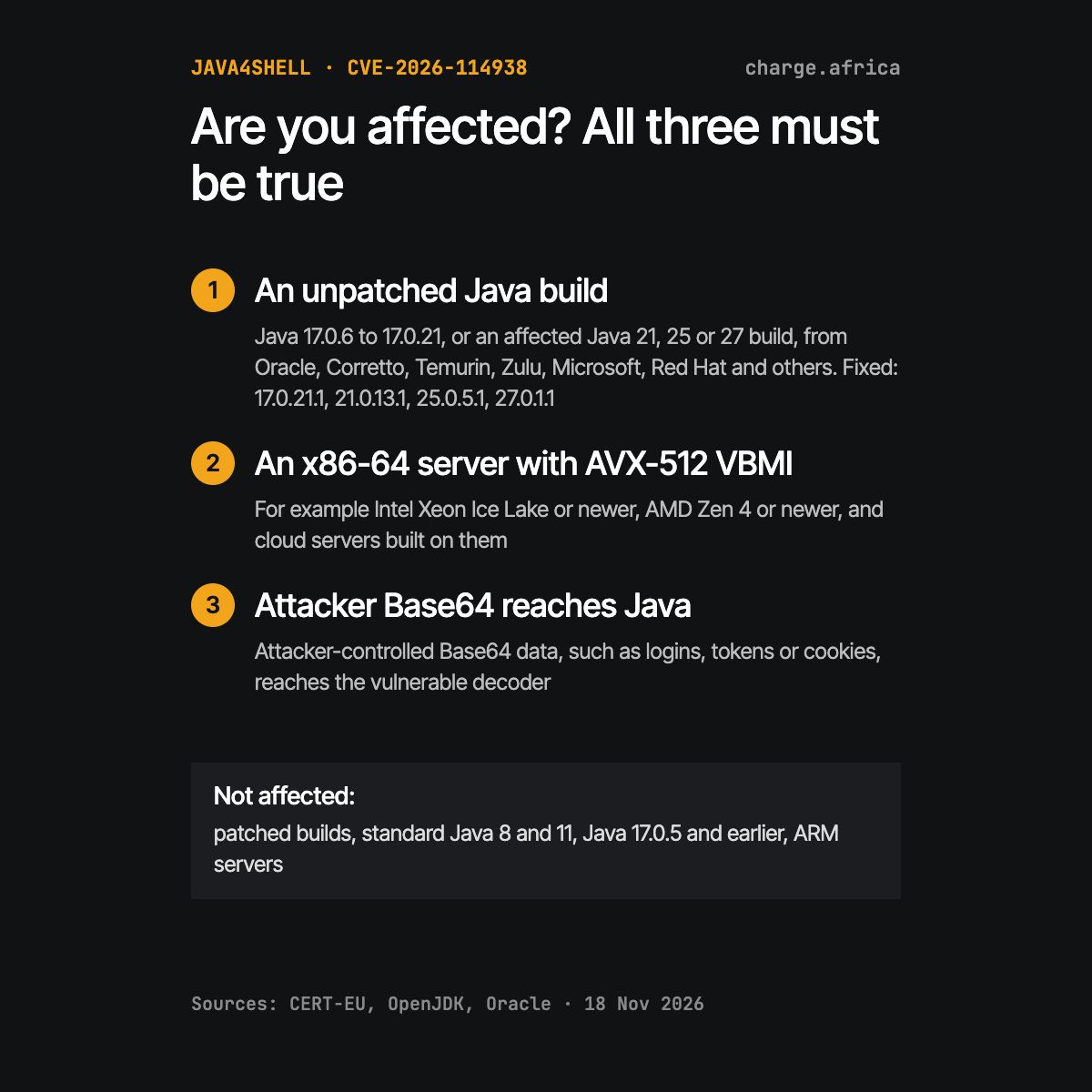
- Java versions: unpatched Java 17 builds from 17.0.6 through 17.0.21, plus affected builds of Java 21, 25 and 27, including the builds from Oracle, Amazon Corretto, Eclipse Temurin, Azul Zulu, Microsoft and Red Hat. Fixed builds include 17.0.21.1, 21.0.13.1, 25.0.5.1 and 27.0.1.1; check your Java vendor’s matching release. Standard Java 8 and 11 are not affected, except Oracle’s Java 8 Enterprise Performance Pack build (CERT-EU, BleepingComputer).
- Hardware: only x86-64 servers whose processors support AVX-512 VBMI, such as Intel Xeon Ice Lake or newer and AMD Zen 4 or newer, including cloud servers built on them. ARM servers are not affected (Blackpoint Cyber, Field Effect).
- Apps: without logging in, on default settings: Keycloak, Jira, Confluence, JFrog Artifactory, Jenkins and PingFederate. With a login: Apache Kafka, Apache Solr, Elasticsearch, Gerrit and Spinnaker. Test apps built on Spring Boot and Apache Struts were also exploited.
What to do about Java4Shell now
- Find every Java install. CISA’s advice includes Java bundled inside other products, containers and appliances, starting with anything facing the internet (Lynnwood Times, Cyber Security News).
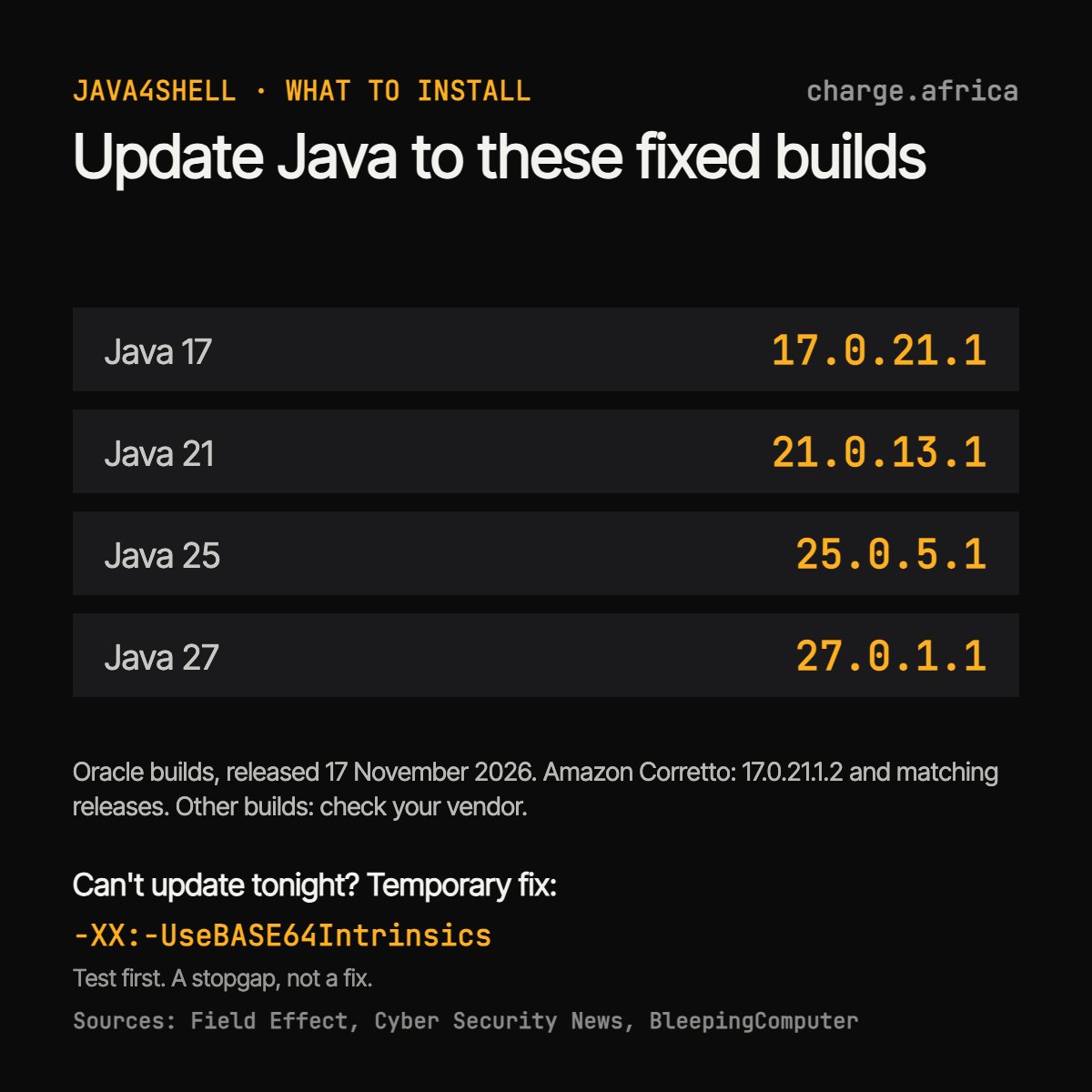
- Update Java. Oracle’s fixed builds are 17.0.21.1, 21.0.13.1, 25.0.5.1 and 27.0.1.1; Amazon Corretto has matching releases (Aikido). If you use another build, check your vendor’s page today.
- Can’t update tonight? Calif’s temporary workaround is to start Java with
-XX:-UseBASE64Intrinsics, which switches off the fast decoder, or-XX:UseAVX=2on x86-64. Test first, and treat both as stopgaps (BleepingComputer). - Update the apps too. Watch for patched releases of Jira, Confluence, Jenkins, Keycloak and the rest, since many ship with their own Java.
An AI found Java4Shell in an hour
Calif researcher Quang Luong pointed OpenAI’s Codex at Java’s internals and found the bug in about an hour, then built a working exploit in about two more, at under $200 in AI costs (BleepingComputer). The same tools are open to attackers, which can shorten the time between a fix shipping and attacks on servers that haven’t been updated. For security teams in Nigeria, Kenya, South Africa and beyond, patching speed now matters as much as the patch.
What’s next
Nigeria’s national CERT (ngCERT) had not posted an advisory on its public advisories page when we checked on 17 November. If you run products that bundle their own Java, check each maker’s security page for an update.
Related: Microsoft outage: what happened to Outlook and Teams · A war far away can switch off your apps