
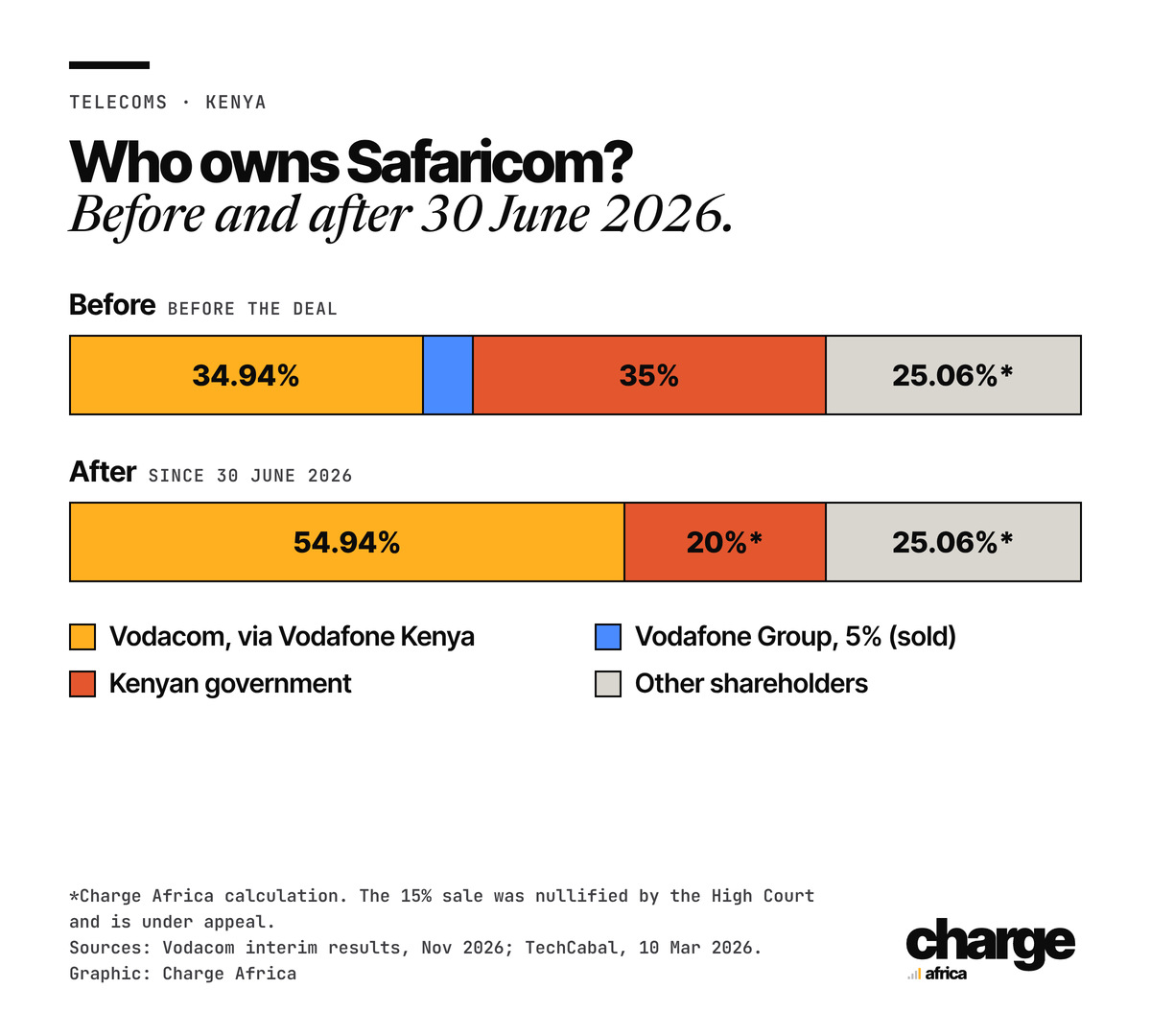
Who owns Safaricom? Since 30 June 2026, South Africa’s Vodacom Group has held an effective 54.94% of the Kenyan telecoms and M-Pesa operator, according to Vodacom’s interim results. But a Kenyan court has ruled that part of the deal is void, and the final answer now sits with the Court of Appeal.
- Vodacom controls about 55% of Safaricom after buying 15% from Kenya’s government and 5% from Vodafone.
- The government’s stake fell from 35% to about 20%; other shareholders hold the rest.
- The High Court nullified the government sale on 15 September 2026; the appeal is pending.
Key facts
- Vodacom’s effective stake in Safaricom rose from 34.94% to about 54.94% on 30 June 2026 (Vodacom).
- Vodacom paid R25.8 billion in cash for the government’s 15%. Kenyan parliamentary committees backed that sale at KES 204 billion ($1.5 billion), TechCabal reported.
- On 13 October 2026, the Court of Appeal ordered the status quo kept until it hears the appeal, so Vodacom remains the registered owner for now (Vodacom).
Safaricom runs M-Pesa, the mobile money service Kenyans use to pay, save and borrow on their phones. Who owns Safaricom decides who sets its strategy, who collects its dividends and who backs its expansion into Ethiopia.
Why it matters: for Kenya, the deal swapped part of a public asset for cash to fund infrastructure. For the rest of Africa, it makes Vodacom the controlling owner of Safaricom and M-Pesa in Kenya, alongside its operations in South Africa, Egypt, Tanzania, the DRC, Mozambique and Lesotho.
Who owns Safaricom now?
Charge Africa compiled the list of Safaricom shareholders before and after the deal from Vodacom’s and Vodafone’s results and TechCabal’s reporting.
- Vodacom Group (through Vodafone Kenya Limited): 34.94% before the deal; 54.94% since 30 June 2026.
- Vodafone Group (direct, through its 12.5% of Vodafone Kenya): 5% before; 0% since, sold to Vodacom. Vodafone still owns Safaricom indirectly as Vodacom’s majority shareholder.
- Government of Kenya: 35% before; 20% since.
- Other shareholders: about 25% before and since.
Sources: Vodacom interim results, November 2026; Vodafone half-year results; TechCabal, 10 March 2026. The 15% sale is under appeal.
The structure explains the odd numbers. Safaricom’s shares sit with Vodafone Kenya Limited, a holding company. Before the deal, Vodacom owned 87.5% of it and Vodafone owned 12.5%, giving Vodacom an effective 34.94% of Safaricom.
On 30 June, Vodacom bought Vodafone’s 12.5% of the holding company for R9.0 billion. The holding company then bought 15% of Safaricom from the Kenyan government. The result is the “about 55%” figure you will see quoted.
How Vodacom got to 55%
- 4 Dec 2025: Vodacom announces deals to raise its effective stake by 20%.
- 10 Mar 2026: parliamentary committees back the government’s 15% sale.
- 26 Jun 2026: the Court of Appeal stays a High Court order that had paused the deal.
- 30 Jun 2026: the deal completes; Safaricom becomes a Vodacom subsidiary.
- 15 Sep 2026: the High Court nullifies the government’s 15% sale.
- 13 Oct 2026: the Court of Appeal declines to suspend that judgment and fast-tracks the appeal; Vodacom says it also ordered the status quo kept.
Sources: Vodacom interim results, November 2026; TechCabal, 10 March 2026; Citizen Digital.
The parliamentary committees supported sending the money to Kenya’s National Infrastructure Fund for roads and energy projects, TechCabal reported. Treasury officials argued that a partial sale would raise money without adding to public debt.
What Vodacom paid, and the gain that isn’t cash
Vodacom paid R25.8 billion for the 15% stake, R9.0 billion for Vodafone’s share of the holding company and R5.1 billion (KES 40.2 billion) for the right to part of the government’s future Safaricom dividends, according to its results.
Vodacom funded it with R35 billion of debt, and its net debt rose by R78.8 billion year on year to R135.6 billion, the company says.
Taking control also produced large gains on paper. Vodacom booked a one-off R23.1 billion gain from revaluing the Safaricom stake it already held, and its parent, Vodafone, booked a €3.0 billion non-cash gain on taking control (Vodafone half-year results). TechCabal put that at KES 430.2 billion ($3.3 billion), TechCabal reported on 25 November.
Neither is money received. Accounting rules require a company to revalue an investment when it takes control.
What the court case means for who owns Safaricom
A petition heard by the High Court on 29 June argued that the government’s sale was unlawful. In its 15 September judgment the court nullified the sale. It found that the public had not been properly consulted and that the sale’s effect on control of Safaricom was not adequately disclosed. It also faulted the pricing, the lack of a competitive process and the absence of a national-security review (Nation).
The government, Vodafone Group and Vodafone Kenya have all appealed, and the petitioners have appealed parts of the judgment too. Vodacom says it expects an appeal date to be set before the end of December 2026.
On 13 October the Court of Appeal declined to suspend the High Court judgment, Kenyan media reported (The Standard, Citizen Digital). Vodacom says the court also ordered the status quo on the shares and the purchase money to be kept and fast-tracked the appeal, so the shares stay registered to Vodafone Kenya, its wholly owned holding company, for now. Vodacom says that if the appeal fails, it will reassess how it accounts for Safaricom.
What it means for M-Pesa users and investors
Safaricom remains a separate company listed on the Nairobi Securities Exchange, and a change of shareholders does not by itself change anyone’s M-Pesa account. As part of the deal, M-Pesa Africa Limited, previously a joint venture between Vodacom and Safaricom, became a Vodacom subsidiary, according to Vodacom’s results.
For investors across Africa, the deal shows how telecoms control is consolidating. In South Africa, Vodacom has also just partnered with Absa on banking and mobile, as we covered in our Shoprite DNI deal explainer, while MTN is in talks to buy Telkom. For Kenya’s tech rules more broadly, see our report on the Kenya–EU data adequacy deal.
How we checked this: To answer who owns Safaricom, Charge Africa read Vodacom’s interim results booklet, including Note 10 on the Safaricom acquisition, on 25 November 2026. The government’s 35% starting stake comes from TechCabal; its 20% stake after the sale and the roughly 25% held by other shareholders come from Vodafone’s half-year results, which also give Vodafone’s gain.
Who owns Safaricom: quick answers
Who is Safaricom’s biggest shareholder?
Vodacom Group, with an effective 54.94% held through Vodafone Kenya Limited since 30 June 2026, according to Vodacom.
Does the Kenyan government still own Safaricom shares?
Yes. It held 35% before selling 15%, which leaves about 20% by our calculation, plus a deal that sold Vodacom part of its future dividends.
Why did the High Court nullify the sale?
It found the public had not been properly consulted, the effect on control of Safaricom was not adequately disclosed, and the pricing, process and lack of a national-security review were flawed (Nation). The ruling is under appeal.
Is Vodafone still a Safaricom shareholder?
Not directly. Vodafone sold its 12.5% of Vodafone Kenya Limited to Vodacom, but as Vodacom’s majority shareholder it still owns Safaricom indirectly.
What’s next
Vodacom expects the Court of Appeal to set a hearing date before the end of December 2026. Charge Africa will update this page when the date is set and when the court rules on who owns Safaricom’s disputed 15%. If you hold Safaricom shares or work with M-Pesa, tell us what you want explained at [email protected].
Last fact-checked 25 November 2026 against Vodacom’s interim results for the six months to 30 September 2026 and TechCabal’s reports of 10 March and 25 November 2026.