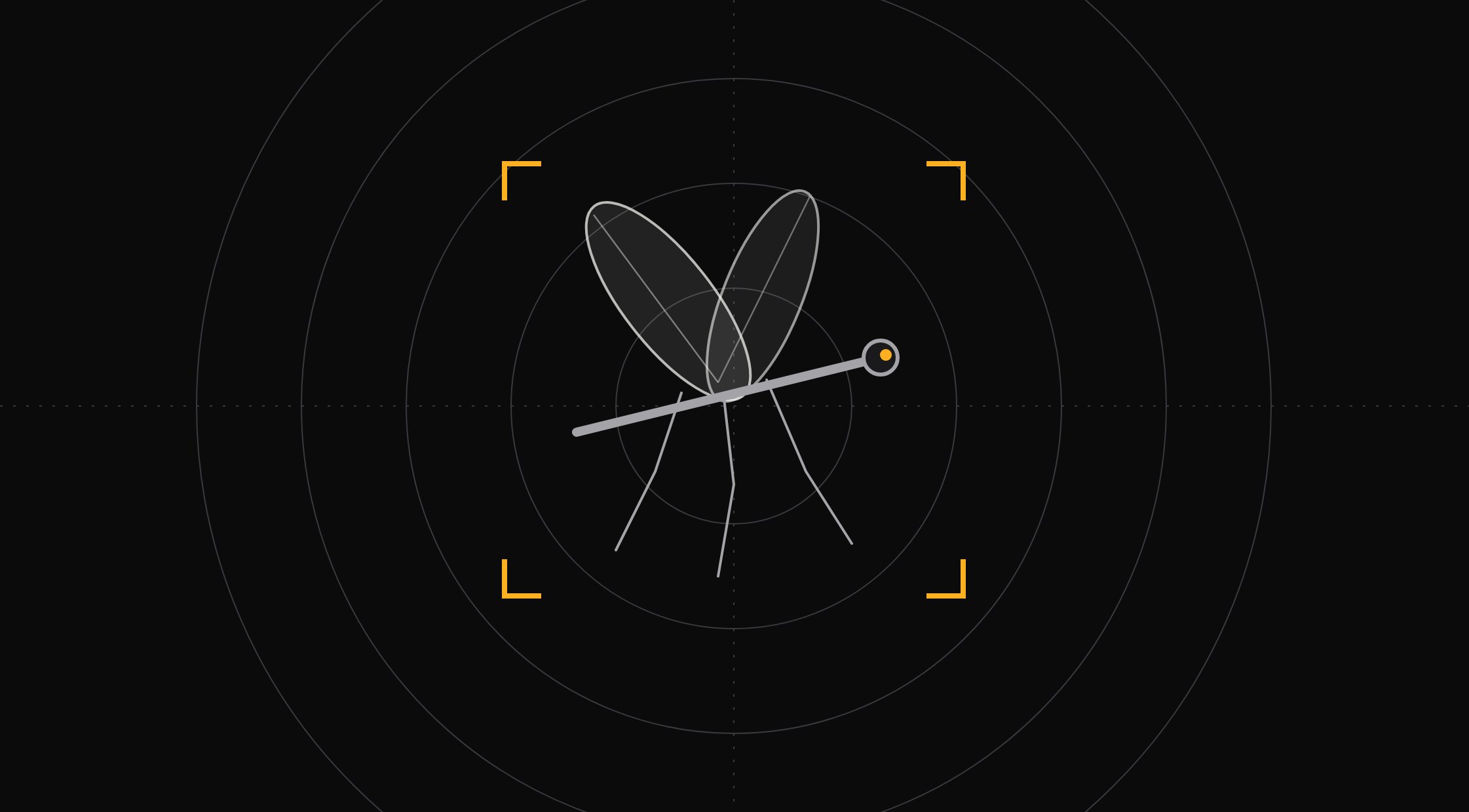

In June 2025, China’s National University of Defence Technology showed a mosquito-sized drone prototype that a student said could be suited to battlefield reconnaissance. Its sensors, range and operational use have not been publicly demonstrated.
Key facts
- The microdrone was shown on CCTV-7, China’s state military TV channel, in June 2025. Newsweek dates the report 14 June; Euronews says 20 June.
- It is about 2 cm long (Newsweek, Euronews), with two leaf-like wings and three hair-thin legs (SCMP).
- Euronews puts its weight at 0.3 grams. Newsweek says it weighs under 0.2 grams.
The National University of Defence Technology (NUDT) is a military university in Hunan province, central China. A robotics lab there built the drone, which a student held up between his fingers on camera, the South China Morning Post reported.
The device is not new. But the question it raises remains: what happens when surveillance hardware gets harder to spot or detect?
If drones this small become operational and widely available, agencies in countries such as Nigeria and Kenya could face a harder detection and enforcement problem. There is no public evidence that this prototype has been deployed there.
What did China unveil?
NUDT student Liang Hexiang presented the drone on CCTV-7. “Here in my hand is a mosquito-like type of robot,” he said, as quoted by Euronews.
Its stick-shaped body carries two tiny, leaf-like wings and three hair-thin legs, according to SCMP. The lab also showed a four-winged prototype that can be controlled from a smartphone.
Euronews, citing South Korea’s Chosun Ilbo, reported that the wings flap 500 times a second. We could not confirm that figure independently.
What is it for?
Liang said such micro-robots are “especially suited to information reconnaissance and special missions on the battlefield”, the South China Morning Post reported. Reconnaissance means gathering information on an opponent’s positions and movements.
The CCTV report did not say what data the drone can collect, Euronews noted. No range, flight time or sensor details have been published.
Experts cited by Euronews say its size would make it hard to detect with conventional radar.
How useful is it, really?
Analysts are cautious. Bryce Barros, a security fellow at the Truman National Security Project in Washington, DC, told Newsweek its impact on wartime surveillance “will likely be minimal”, given “its limited capacity, short range, and presumable short battery life”.
Timothy Heath, a senior international defence researcher at the RAND Corporation, told The Telegraph that China would likely use such drones for intelligence and surveillance, “especially in places that larger drones struggle to access, such as indoor areas”, as quoted by Newsweek.
Building one is hard. Sensors, power, and control circuits must fit into a tiny body, requiring micro-engineering, materials science, and bionics (design borrowed from living things), according to SCMP.
China is not the only one going small
- Black Hornet. A palm-sized, helicopter-style drone of Norwegian origin, now produced by Teledyne FLIR Defense and used by dozens of armed forces, including the US military (Newsweek, Euronews). The company says the Black Hornet 4 has a thermal imager, a range of more than 2 km and a flight time of more than 30 minutes (Teledyne FLIR).
- RoboBee. An insect-like robot from Harvard that flaps its wings about 120 times a second using artificial muscles (Newsweek).
- HI-MEMS. In 2006, DARPA, the US Defense Department’s research agency, launched a project to place micro-mechanical systems inside insects (Euronews).
What it means for Africa
Tiny military drones are a niche today. But the same shrinking sensors and batteries drive commercial drones too, and Newsweek notes the concerns that come with them: personal privacy and criminal use.
For regulators in Nigeria, Kenya and beyond, that shifts the question from “who is allowed to fly?” to “can we even tell something is flying?” A device that experts say is hard to pick up on conventional radar is hard to license, track or police.
For African builders in drones and security tech, our view: the bigger opening may lie less in making tiny drones than in detecting them.
What’s next
NUDT has not published range, flight time or sensor data, and there is no public sign the drone has been deployed. Watch for test results, and for how quickly detection technology catches up.