
The NCC MVNO rules give Nigeria’s mobile networks 20 days to answer a virtual operator’s request to use their network, and 120 days at most to sign a deal. The Nigerian Communications Commission has published them as the Business Rules for MVNO Operations in Nigeria 2026, marked final and dated November 2026 (NCC).
- The NCC’s final rules set deadlines for networks to answer virtual operators.
- They also set how revenue is shared between the two, by licence tier.
- Only three of the 46 virtual operators licensed since 2023 have launched, Technext reports.
Key facts
- The NCC released draft business rules for mobile virtual network operators in May 2026, BusinessDay reported.
- It held a public inquiry on the draft on 16 July 2026, according to the NCC’s report of the inquiry.
- The rules, first described by Technext require a host network to accept, refuse with reasons, or set conditions within 20 days. The final version, published by the NCC in November, also gives hosts 120 days at most to sign an agreement.
A mobile virtual network operator (MVNO) sells its own SIM cards and data plans but runs on another company’s network. In Nigeria, the hosts are the major mobile network operators that control the telecoms infrastructure, as BusinessDay puts it.
Why it matters: since 2023 the NCC has licensed 46 virtual operators, but only three have launched, according to Technext: Vitel Wireless, EMOSIM and Lebara. Rules that force faster answers from host networks could mean more SIM brands for Nigerians, including ones from banks, fintechs and retailers, as South Africa already has.

What are the NCC MVNO rules?
They are business rules setting out how virtual operators and host networks deal with each other. The NCC’s inquiry report says the draft covers onboarding, hosting, numbering, SIM and eSIM management, quality of service, revenue sharing, consumer protection and dispute resolution.
The NCC put the draft to a public inquiry on 16 July 2026, with 190 participants attending online and others in person, according to its report. The report describes the inquiry as a step “before its finalization”.
The final version, Business Rules for MVNO Operations in Nigeria 2026, is now on the NCC’s website, marked “Status Final” and dated November 2026 (NCC). It says the rules take effect on a date the Commission will specify.
What the NCC MVNO rules change
The core change is a timetable. BusinessDay reported in May that many licensees were stuck in lengthy negotiations with host networks over access and wholesale prices.
The steps, from the NCC’s final rules:
- Request received, 10 days: acknowledge in writing, name its negotiation and technical leads, and flag missing information.
- Decision, 20 days: confirm readiness with a timeline, or name specific conditions. A refusal needs written reasons, sent to the MVNO and the NCC.
- Technical talks, 10 days after a yes: start technical negotiations on network design.
- Launch planning, 10 days after commercial terms: form a joint onboarding working group and adopt a launch plan.
- Agreements, 120 days: signed within 120 days of a complete request (only the NCC can extend that) and filed with the NCC within 14 days.
Source: NCC, Business Rules for MVNO Operations in Nigeria 2026.
The rules also bar hosts from deferring requests indefinitely, suspending timelines on their own, or cutting a virtual operator’s service solely over a settlement dispute, Technext reported. If talks stall, the NCC can impose deadlines.
Who keeps the money
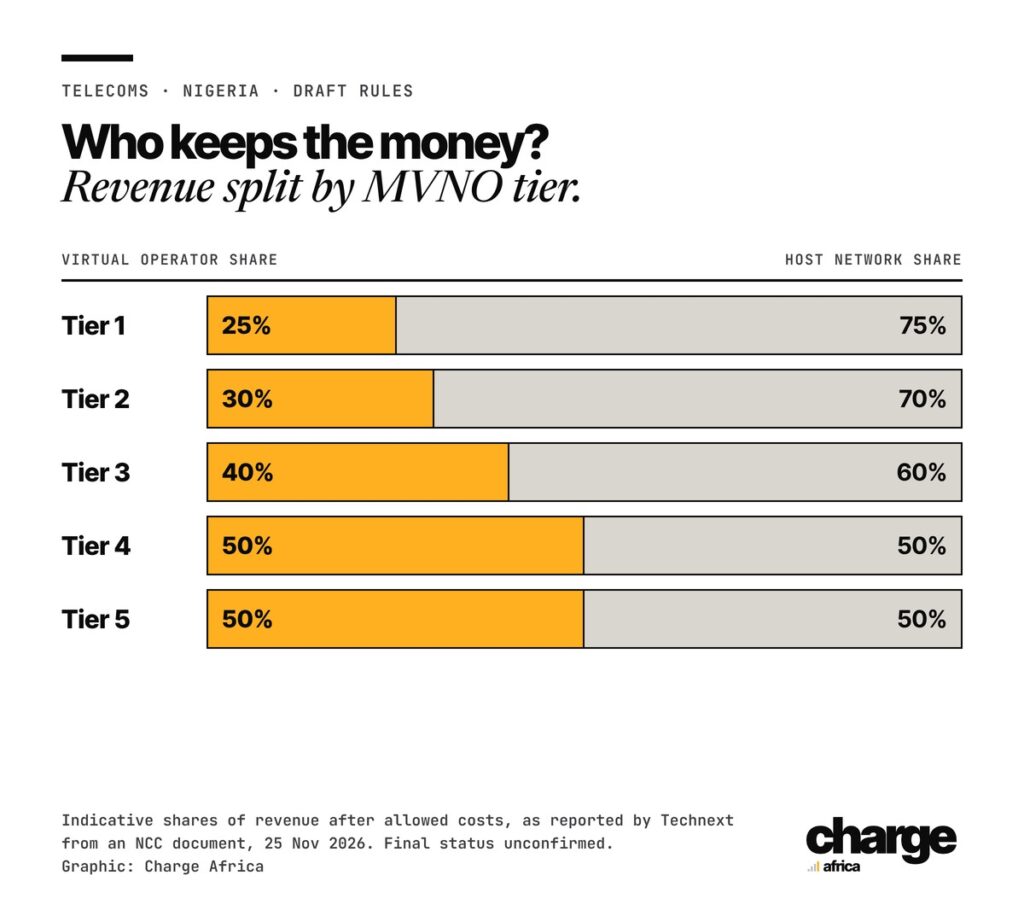
The rules also set indicative revenue shares by licence tier. Before the split, only these costs can be deducted: interconnect costs for calls and SMS, bandwidth costs for data, and other costs the NCC approves.
A Tier 1 virtual operator keeps 25% and the host 75%. Tier 2 keeps 30%, Tier 3 40%, and Tiers 4 and 5 split revenue 50:50 with their host. One wrinkle: section 10(8) calls these shares “indicative”, while section 10(14) calls them “binding guidance”.
Both sides have to keep billing, call, recharge and usage records that the NCC can audit. The rules also ban predatory pricing and “margin squeeze”, where a host prices wholesale access so high that a virtual operator cannot compete on retail prices.
Who backed the draft and who objected
The NCC’s inquiry report shows a split. Some participants generally supported the draft, including its onboarding obligations, limits on deductions and the proposed Tier 5 revenue share. Some asked for more: mandatory wholesale access, stronger enforcement and higher Tier 5 shares.
Others opposed mandatory hosting and regulated pricing, and argued that commercial negotiation should decide terms. The final rules keep both the onboarding deadlines and the tiered revenue shares.
What it means for Nigerians and builders
For customers, more working virtual operators could mean more choice of SIM plans built for specific groups, such as the travel eSIMs EMOSIM already sells. For banks, fintechs and retailers, a clear timetable could make a branded SIM a realistic product, as it has become for South African banks and Shoprite, which we covered in our Shoprite DNI deal explainer.
For the big networks, the rules limit how long they can take and how much they can keep. For more on how the NCC is regulating SIMs this year, see our guide to the *315# disconnection check.
How we checked this: Charge Africa read the NCC’s inquiry report and the final Business Rules for MVNO Operations in Nigeria 2026 on the NCC’s website. The deadlines and revenue shares come from the final rules. The draft’s May release comes from BusinessDay.
NCC MVNO rules: quick answers
Are the NCC MVNO rules final?
Yes. The NCC has published the Business Rules for MVNO Operations in Nigeria 2026 marked “Status Final”. They take effect on a date the NCC will specify.
What is an MVNO?
A mobile virtual network operator sells its own SIM cards and plans using another company’s network, instead of building its own masts.
How many MVNOs have launched in Nigeria?
Three of the 46 licensed since 2023, according to Technext: Vitel Wireless, EMOSIM and Lebara.
How long would a network have to answer an MVNO?
Twenty days from a complete request to accept, refuse with written reasons or set conditions, under the NCC’s final rules. Agreements must then be signed within 120 days.
What’s next
The NCC has not yet said when the rules take effect. If you run or are building a virtual network in Nigeria, tell us what is holding you back at [email protected].
Last fact-checked 26 November 2026 against the NCC’s MVNO public inquiry report, BusinessDay’s report of 22 May 2026 and Technext’s report of 25 November 2026 and the NCC’s final Business Rules for MVNO Operations in Nigeria 2026.