The CBN interest rate decision for November lands on Tuesday 24 November, when the Central Bank of Nigeria’s Monetary Policy Committee (MPC) ends a two-day meeting. Its benchmark rate has sat at 23% since September, and inflation has just fallen to its lowest level in more than six years.
The CBN interest rate decision is due on 24 November; the rate is 23%.
Inflation fell to 14.06% in October, the lowest since September 2020.
Analysts lean towards a hold or a small cut; any change reaches loans slowly.
Key facts
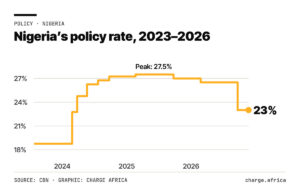
23%: the Monetary Policy Rate since 22 September 2026, when the MPC reset it from 26.5% (CBN Communiqué No. 164).
14.06%: headline inflation in October 2026, the lowest since September 2020, according to National Bureau of Statistics data reported by Nairametrics.
Hold or small cut: what analysts surveyed by Nairametrics expect. The committee announces its decision on 24 November.
The Monetary Policy Rate (MPR) is the price the CBN sets for money in Nigeria. Banks, lenders and the government borrow at rates that move with it, so a change shows up over time in what you pay on a loan and what you earn on savings.
Why it matters: a cut would make borrowing cheaper for traders, small businesses and the fintech lenders that serve them. A hold keeps borrowing costs where they are while the CBN watches prices and the naira.
What is the CBN interest rate decision?
It is the MPC’s call on whether to raise, cut or hold the MPR. The committee meets about every two months, and Nairametrics reports that this is its final scheduled meeting of 2026.
The MPR sits inside a “corridor”: the CBN’s own lending and savings window for banks. Since September the corridor is +50/−300 basis points (CBN Communiqué No. 164). In plain terms, a bank can borrow overnight from the CBN at 23.5% and park spare cash with it at 20%.
Why September’s cut was not what it looked like
On 22 September the MPC took the rate from 26.5% to 23%, a 3.5-percentage-point drop. It was the largest single drop in the CBN’s published list of decisions, which goes back to July 2022. The CBN said it was not a cut in the usual sense.
The committee called it a “reset” and said it “does not constitute a change in the current monetary policy stance” (CBN Communiqué No. 164). Its reason: market rates had drifted far from the official rate, so the MPR had stopped steering them. The reset moved the official rate closer to where money was already trading.
That matters for this week. If September was housekeeping rather than the start of a cutting cycle, the committee has less reason to move again quickly.
Why a cut is on the table now
October’s inflation numbers strengthened the case. Headline inflation slowed to 14.06% from 14.63% in September. Food inflation eased to 19.13%, and core inflation, which leaves out farm produce and energy, fell to 10.78% from 12.95% (NBS data, via Nairametrics).
At 23%, the policy rate is about nine percentage points above inflation. Economists call that a high real interest rate: money stays expensive even after prices are taken into account, which gives the CBN room to cut without losing control.
The case against is still real. Prices rose faster month on month in October (0.43%, up from 0.06%), with housing and energy up 1.97% and transport up 1.86%, Nairametrics reports. In September the CBN itself named election-related spending as a risk to prices.
What analysts expect
Before the October numbers, all five analysts surveyed by Nairametrics expected this week’s CBN interest rate decision to be a hold at 23%. After them, the three who updated their view still lean towards a hold or a small cut.
“I don’t read September’s 350bp cut as the start of an easing cycle,” Igho Erakpotobo of Futureview Financial Services told Nairametrics. Francis Nkem of Iron Capital Asset Management said he expects “a hold or, at most, a marginal cut”.
CBN interest rate decision
Every CBN rate decision since February 2024
Charge Africa compiled this table from the CBN’s own record of MPC decisions. It shows how far rates climbed, and how slowly they have come down.
Meeting
Decision
MPR after
26–27 Feb 2024
Raise
22.75%
25–26 Mar 2024
Raise
24.75%
20–21 May 2024
Raise
26.25%
22–23 Jul 2024
Raise
26.75%
23–24 Sep 2024
Raise
27.25%
19–20 Feb 2025
Hold
27.50%
19–20 May 2025
Hold
27.50%
21–22 Jul 2025
Hold
27.50%
22–23 Sep 2025
Cut
27.00%
24–25 Nov 2025
Hold
27.00%
23–24 Feb 2026
Cut
26.50%
19–20 May 2026
Hold
26.50%
20–21 Jul 2026
Hold
26.50%
21–22 Sep 2026
Reset
23.00%
Source: CBN, Monetary Policy Decisions, checked 23 November 2026. The page does not list the November 2024 meeting; the rate stood at 27.50% when the MPC held it in February 2025.Nigeria’s central bank decides its interest rate on Tuesday, with rates at 23% and inflation at a six-year low.
What a cut or hold means for your money
Loans. Whatever the CBN interest rate decision, banks do not price loans off the MPR alone, so any change reaches borrowers slowly and not always in full. As a simple calculation: every one percentage point on a ₦1 million loan is ₦10,000 a year in interest. A 0.5-point cut, passed on in full, would save ₦5,000 a year on that loan.
Savings and government bills. When the policy rate falls, returns on savings and Treasury bills usually follow it down over time. A hold keeps those returns where they are for now.
Startups and fintech lenders. Lenders that borrow the money they lend out pay more when market rates are high. Cheaper money could ease the price of the loans they offer at the shop till. It also matters for the Nigerian Exchange’s push to list more tech companies, which we covered in NGX wants to double its listings, and comes as big fintechs face tighter CBN supervision under the BOFIA amendment.
CBN interest rate decision: quick answers
What is the current CBN interest rate?
The Monetary Policy Rate is 23%. The MPC set it on 22 September 2026 (CBN).
When is the next CBN interest rate decision?
On 24 November 2026, at the end of the MPC meeting that began on 23 November, according to Nairametrics.
Was September’s move a rate cut?
The rate fell from 26.5% to 23%, but the CBN called it a reset to bring the official rate in line with market rates, not a change in its policy stance.
Does a rate cut make my loan cheaper straight away?
No. Banks price loans off market rates as well as the MPR, so a cut reaches borrowers slowly and not always in full.
What’s next
CBN Governor Olayemi Cardoso usually announces the decision at a press briefing at the end of the meeting, and the communiqué follows on the CBN website. Charge Africa will update this page with the CBN interest rate decision on 24 November.