
Cloudflare for Startups now gives bootstrapped founders $10,000 in cloud credits and venture-backed startups up to $350,000. There’s a catch for anyone building with AI: from 1 December, the credits no longer cover Workers AI, Cloudflare’s tool for running AI models, for startups joining the programme (Cloudflare).
Key facts
- The Cloudflare for Startups credits: $10,000 for bootstrapped startups, $100,000 for startups that raised under $5 million from one of Cloudflare’s partner investors, and $350,000 for those that raised $5 million or more (Cloudflare).
- The change: “Effective Dec 1 and for all incoming startups: Workers AI is not covered by credits,” Cloudflare’s page says. AI Gateway is also temporarily excluded.
- How long they last: one year, or until you use them up, whichever comes first. Cloudflare isn’t granting extensions.
- The Africa footprint: Cloudflare lists 33 African cities in its network, including Lagos, Accra, Nairobi, Johannesburg and Cairo (Cloudflare).
Why it matters: hosting is billed in dollars, so for a founder in Lagos, Nairobi or Accra, a year of free compute is a year without exchange-rate risk on the bill. The $10,000 tier needs no investor at all.
What Cloudflare for Startups gives you
Cloudflare sorts startups into three tiers by how much they’ve raised and from whom (Cloudflare):
- Tier 3, $10,000: bootstrapped or self-funded startups that have raised under $1 million. You get community events, the developer docs and Cloudflare’s Discord.
- Tier 2, $100,000: startups that have raised under $5 million and are funded by one of Cloudflare’s affiliated partners. A Cloudflare account manager may be assigned, depending on the case, and there are technical sessions.
- Tier 1, $350,000: startups that have raised $5 million or more from an affiliated partner. You get an account manager, priority technical support and Solutions Architect office hours every two weeks.
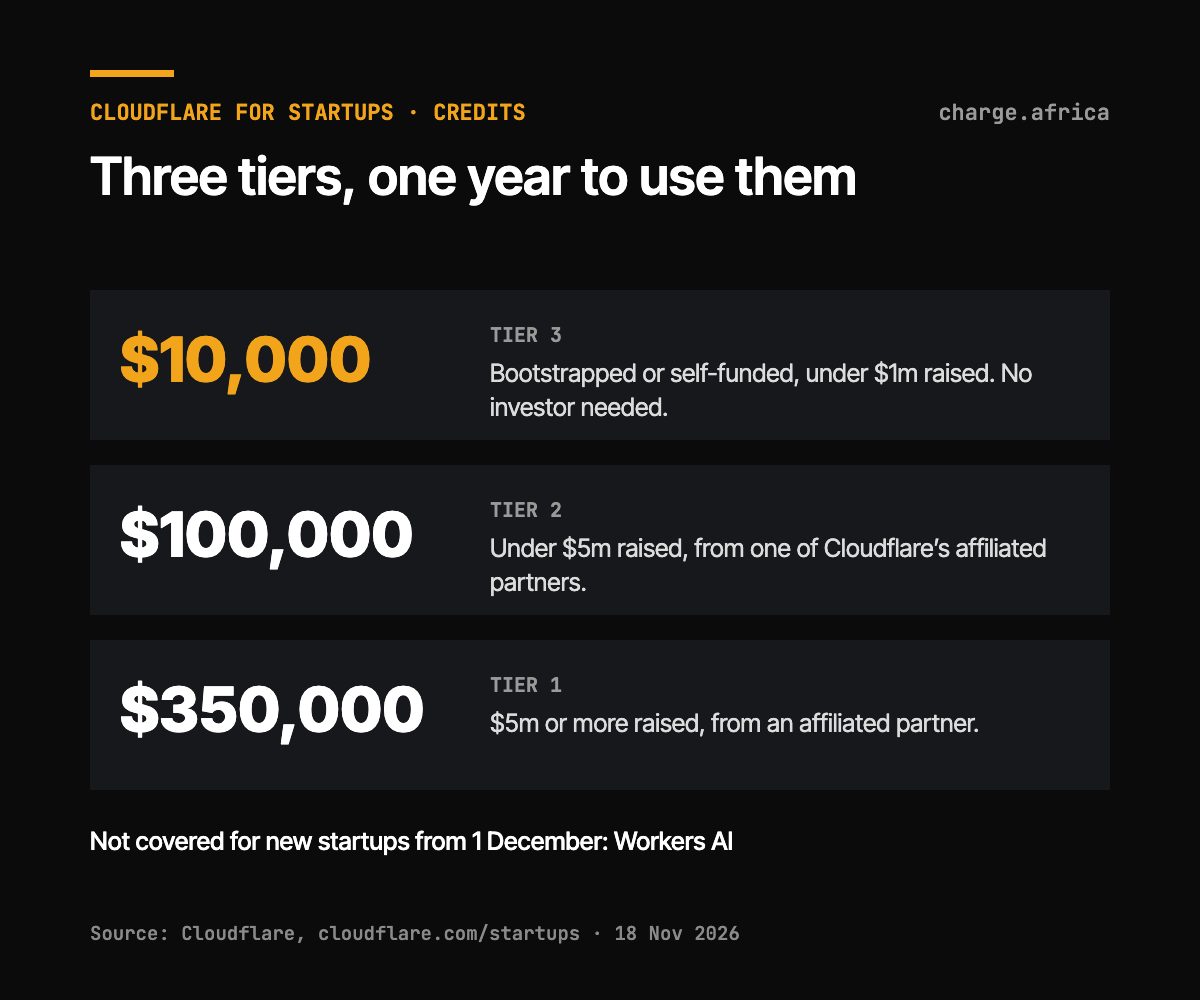
Those amounts are up from $5,000 and $250,000 before. Startups that joined at the old limits can ask for an upgrade, which Cloudflare decides case by case, and an upgrade doesn’t extend the 12 months (Cloudflare).
What the credits cover, and what they don’t
The credits pay for Cloudflare’s developer platform:
- Compute: Workers, which run your code, plus Workers for Platforms, Durable Objects and Workflows.
- Storage and data: Workers KV, the D1 database, Queues, Vectorize and R2 storage, with R2 capped at $10,000.
- Delivery: Pages, Images and Stream, Cache Reserve and Argo Smart Routing.
They don’t pay for:
- Workers AI, for new startups from 1 December. Startups already in the programme keep AI cover until then, capped at $2,500, $10,000 or $50,000 depending on tier.
- AI Gateway, for now. Cloudflare says it is working on it.
- Domain registration fees, enterprise add-ons and premium network services such as Magic Transit and dedicated IP addresses.
Cloudflare says core security and networking features are free on all three tiers, so the credits go on the products you’d otherwise pay for.
For an African AI startup, that changes the maths. If your product calls an AI model on Cloudflare, the model calls now come out of your own pocket after 1 December, even with $350,000 in credits. Hosting, databases and storage are still covered.
Who can apply for Cloudflare for Startups
Cloudflare’s checklist says a startup must (Cloudflare):
- have been incorporated in the last 10 years;
- be actively building a technology product;
- have a live website that anyone can check;
- be active on LinkedIn, X or GitHub;
- be a for-profit business, applying with an email address on its own domain (not Gmail); and
- never have been approved for the programme before.
The page also says “funded up to Series B, within the last 12 months”. That doesn’t fully match the self-funded tier, so if you’ve never raised money, say so plainly in your application.
Who can’t apply: educational institutions, personal blogs, consultancies, service agencies, managed service providers and resellers. That rules out a lot of Nigerian tech businesses that build for clients rather than selling their own product.
The page doesn’t limit applications by country.
Why Cloudflare’s African network matters
Cloudflare runs servers in 348 cities, it says, and 33 of them are in Africa. In Nigeria, it lists Lagos only; there is no Abuja or Port Harcourt location. Kenya has Nairobi and Mombasa, Ghana has Accra, South Africa has Johannesburg, Cape Town and Durban, and Egypt has Cairo (Cloudflare).
That matters because Workers code runs on the server closest to each user. A reader in Port Harcourt can be served from Lagos rather than from Europe, which usually means a faster page.
We’ve seen this ourselves. Charge Africa’s games, including Jollof Express, run on one Cloudflare Worker with a D1 database for the leaderboard, on the free plan (how we built it). The free plan allows 100,000 requests a day on Workers. The credits matter once you outgrow that.
How to apply
- Make sure your website is live and your LinkedIn, X or GitHub shows recent activity.
- Use an email address on your company’s domain.
- Apply at cloudflare.com/lp/startups. For Tier 1 or 2, name the partner investor that funded you.
- Cloudflare says review takes up to 48 hours, and you’ll get a confirmation email.
The programme is a one-off: you can only be approved once, and credits can’t move between accounts. Credits last 12 months, so apply when you’re ready to build, not months before.
What’s next
The Workers AI change takes effect on 1 December. If you’re already a member and use Workers AI, your capped cover runs until then. If you’re applying now and need AI, budget for those model calls separately, or check the AI credits in other startup programmes before you choose where to build.
Disclosure: Charge Africa runs its browser games on Cloudflare’s free plan.
Related: Mozilla Fellowship 2027: up to $125,000 for builders · How to build a browser game with AI